
Is Commerce AI Fintech SaaS consumers the recursive inflection point where the value of the 5 layer cake eco-system becomes monetised by end consumers?
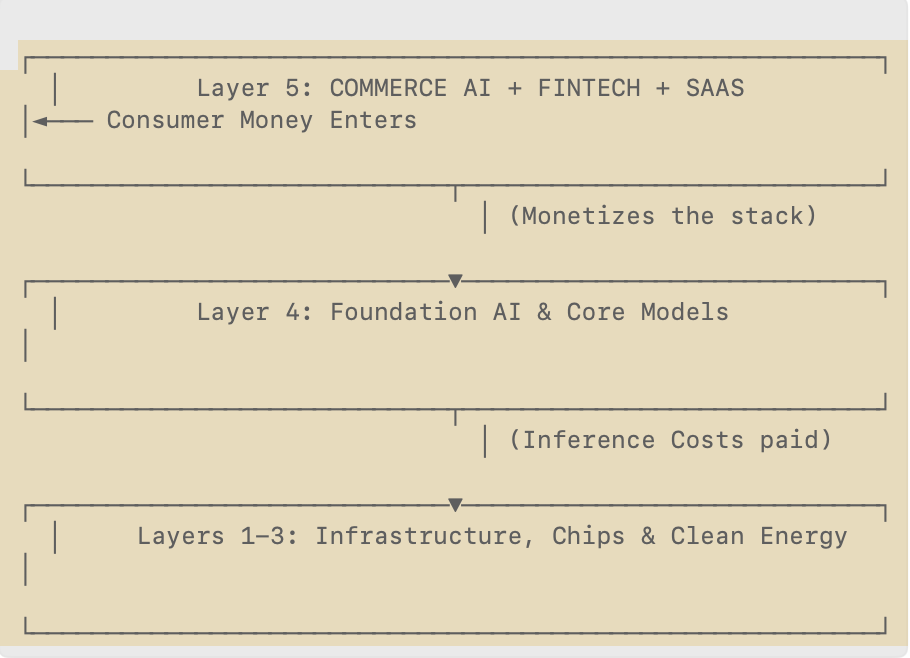
Yes, absolutely. The intersection of Commerce AI, Fintech, and SaaS represents the definitive consumer application layer where the enormous, capital-intensive investments made across the “5-layer AI cake” are finally justified and monetised through real-world consumer transactions.
By merging these three domains into user-facing platforms, companies translate raw, abstract tokens into everyday economic activity like instant checkouts, personalised shopping agents, and automated financial decision-making.
The 5-Layer AI Cake Framework
To understand why this is a “recursive inflection point,” look at the infrastructure stack popularised by NVIDIA CEO Jensen Huang:
- Energy: Powering massive data grids.
- Chips: High-performance hardware (GPUs/TPUs).
- Infrastructure/Cloud: Hyperscale hosting environments.
- Models: Foundation LLMs manufacturing raw intelligence.
- Applications: Tailored, specialised software solving human problems.
Upstream players in layers 1–3 book massive revenues upfront by selling physical, verifiable inputs. However, layers 4 and 5 must capture direct consumer revenue to sustain the trillions of dollars flowing back down into the physical layers.
Why it is a “Recursive Inflection Point”
The fusion of Commerce, Fintech, and SaaS creates a powerful feedback loop that converts consumer intent directly into real revenue:
- Fintech as the Monetisation Pipe: Without integrated financial systems (like embedded payments, dynamic fraud prevention, and credit APIs), an AI application is just a novelty chatbot. Fintech turns AI interactions into real, legally binding monetary transactions.
- SaaS as the Operational Core: Software-as-a-Service architecture ensures the user experience is continuous, context-aware, and scalable, allowing consumer behaviour to feed data directly back into the system to improve the AI model.
- Commerce AI as the Catalyst: Consumer-facing agents transition the internet from static “search and discovery” to “agentic commerce”. Users no longer just click links; they tell an AI to find, negotiate, purchase, and split a product bill in a single command.
Real-World Proof of Value Realisation
Major ecosystem protocols highlight how this inflection point is materialising:
- In-Chat Native Checkouts: Ecosystem integrations—such as the collaborations connecting OpenAI with Stripe or Google’s Universal Commerce Protocol with Shopify—allow end-consumers to purchase products natively inside chat interfaces without ever visiting an external storefront.
- Conversion and Cart Optimisation: Enterprise tools like Rep AI and Tidio’s Lyro process conversational shopping interactions, reducing friction and directly recovering massive order volumes previously lost at checkout.
- Hyper-Personalized Ecosystem Shift: Consumers increasingly shift from traditional search funnels to personalized, autonomous transactions. This activity drives high-margin processing and subscription revenue, which flows directly down to pay for the underlying GPU computing time and infrastructure electricity.
The Looming Bottleneck
While the technical infrastructure is scaling rapidly, a distinct socio-technical disconnect remains the main bottleneck. While businesses are aggressively building backend AI automation networks, individual consumers still exhibit significant caution regarding trust, transparency, and data privacy in completely autonomous financial transactions. The SaaS layers that successfully build deep consumer trust will ultimately hold the highest pricing power in the ecosystem.